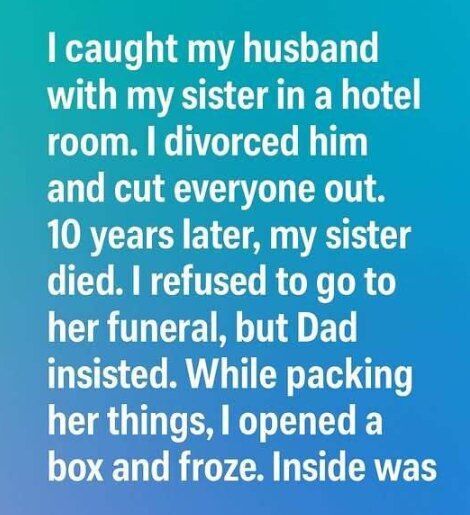
There are moments that split your life clean in two — before and after.
Mine happened in a hotel hallway that smelled of carpet cleaner and recycled air. I remember the hum of the vents, the patterned floor beneath my shoes, the way my heart felt oddly calm. I had followed a small inconsistency in my husband’s story, feeling almost foolish for doubting him.
Then the door opened.
He was standing there.
Beside my sister.
I don’t remember breathing. I don’t remember blinking. I only remember the sound of something inside me closing — like a lock turning for the last time.
I didn’t scream.
I didn’t ask for explanations.
I just walked away.
In that silence, my marriage ended. So did my relationship with my sister. And the part of me that trusted without fear disappeared with them.
I moved quickly after that. Divorce papers. Blocked numbers. Holidays declined. I built a life that looked strong from the outside — a rebuilt career, new friends, a steady independence. People admired my resilience.
What they didn’t see was how tightly I clung to anger. It felt safer than grief. Anger kept me upright. If I let it soften, I was afraid I would collapse under the weight of betrayal.
When my sister got sick, I stayed away. Pride and pain hardened into habit. By the time she was gone, there were no words left between us — only silence.
After her funeral, my father asked me to help clear her apartment. It felt like walking into a paused memory. Her coffee mug still by the sink. A sweater draped over a chair.
In the back of her closet, I found a ribbon-tied box from our childhood. Inside was her journal.
My hands shook as I opened it. I expected excuses. Lies. Justifications.
Instead, I found fear.
She had suspected my husband long before I had. She wrote about the uneasy feeling she couldn’t shake, about watching him too closely, about deciding to confront him privately because she didn’t want to wound me without proof.
That afternoon in the hotel wasn’t what I thought.
She had been demanding answers. Pushing him. Trying — clumsily, imperfectly — to protect me.
And then I had walked in.
Her entries weren’t defensive. They were filled with regret. She wrote about calling my number and hanging up. About standing outside my apartment and losing the courage to knock. About believing there would be more time to fix it.
There wasn’t.
In the final pages, her handwriting trembled.
“I hope someday she understands.”
Not “forgive me.”
Not “believe me.”
Just understand.
Something inside me broke open when I read that.
For ten years, I had carried a story that kept me alive. A story where she was the villain and I was the survivor. Letting go of that certainty felt like losing my balance.
But as I sat on her bedroom floor, journal pressed to my chest, the anger that had sustained me began to loosen. Beneath it was grief — raw and aching and terribly human.
I finally allowed myself to miss her.
To remember the sister who braided my hair, who shared secrets under blankets, who made mistakes and tried, too late, to fix them.
Forgiveness didn’t arrive as a grand gesture. It came quietly — as understanding that love and failure can exist in the same moment. That intentions can be good and outcomes devastating. That silence, sometimes, wounds more deeply than betrayal.
The past didn’t change. The years apart remained. The lost time could not be restored.
But the weight I carried shifted.
And in that shift, I found something softer than anger. Something braver than pride.
I found mercy.
Not the kind that rewrites what happened —
but the kind that finally lets you set it down
and breathe.